
Walking the Camino on a 2,000-Year-Old Roman Road
/
As we walk the Camino, there are moments when the modern world quietly slips away. A yellow arrow points down a cobbled lane, church bells echo in the distance, and beneath our feet lies something far older than the pilgrimage itself — the stones of an ancient Roman road.
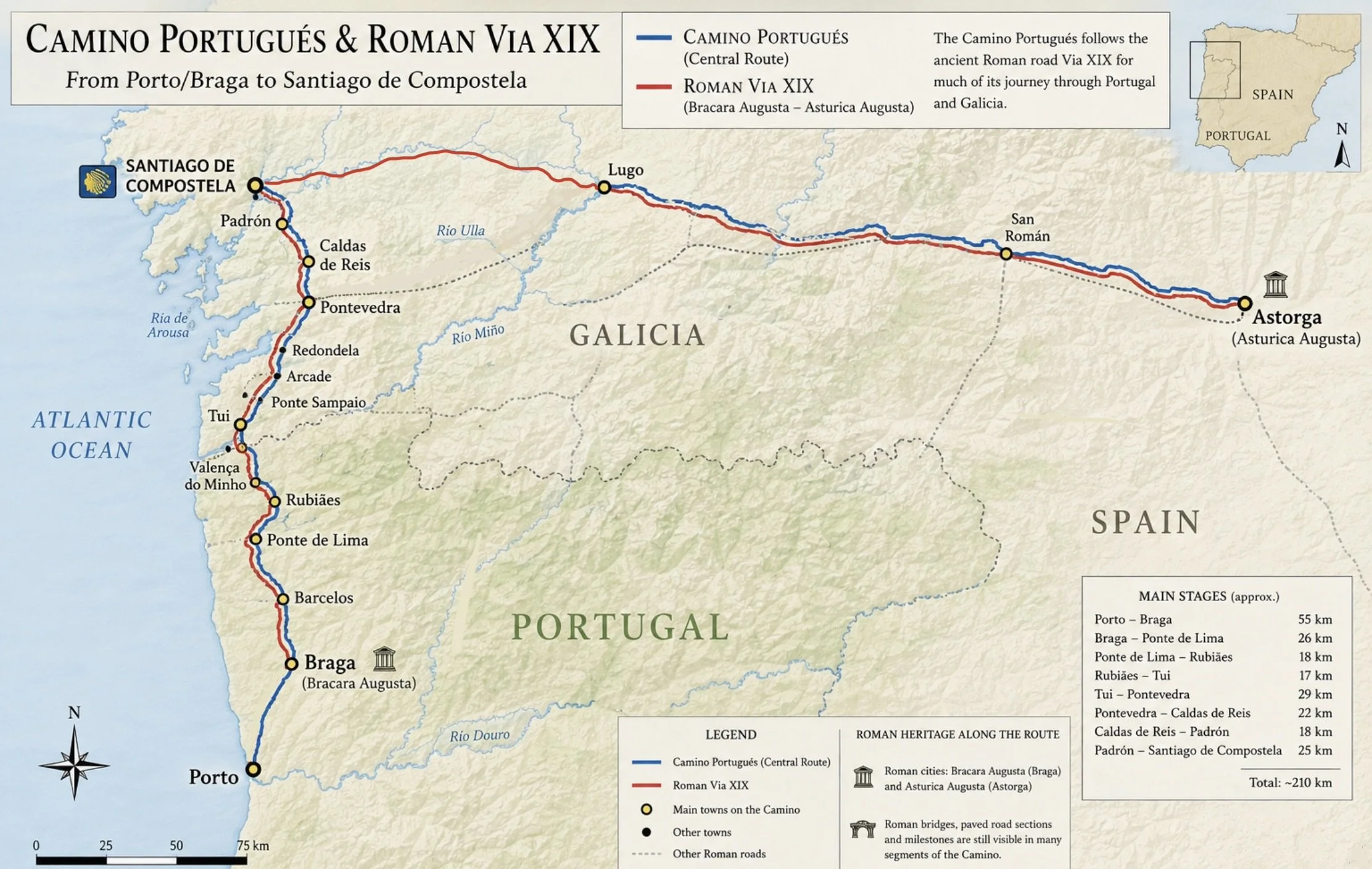
Again and again, we are reminded that much of the Camino Portugues follows the route of the Via XIX, one of the great Roman roads built in the first century AD. This road connected Bracara Augusta — modern-day Braga — with Asturica Augusta, now Astorga. Along the way it passed through towns we have already visited or soon will: Ponte de Lima, Rubiães, Tui, Pontevedra, and Caldas de Reis.
It is astonishing to think that these same routes once carried Roman soldiers in armor, merchants with heavily loaded carts, imperial messengers changing horses at roadside stations, and travelers moving across an empire that stretched across much of Europe, North Africa, and the Middle East.
The Roman Empire eventually built more than 50,000 miles of roads. At first, these roads were military infrastructure, designed so legions could move quickly to troubled frontiers or rebellious provinces. Speed mattered. A Roman army could march astonishing distances because roads made movement efficient in all weather.
But the roads quickly became something more important. Trade flourished along them. Olive oil, wine, grain, pottery, metals, and textiles moved across continents. Towns grew where roads intersected. Ideas and cultures travelled with equal ease. In many ways, the Roman road network became the circulatory system of the ancient world.
What amazes me most is not only that the Romans built these roads, but how they built them so incredibly well that many survive today.
Roman road building was not crude labour with loose stones thrown onto dirt tracks. It was precise engineering.
Before construction began, Roman surveyors carefully planned the route using instruments that allowed surprisingly accurate measurements. Whenever possible, they built roads in remarkably straight lines, even if it meant cutting through hills or building embankments across valleys. The Roman attitude seemed to be that nature should adapt to the road, not the other way around.
Once the route was chosen, workers dug a trench several feet deep. This foundation was essential because durability depended on stability beneath the surface. Large stones were laid at the bottom to create a solid base layer known as the statumen. Above this came layers of smaller stones and gravel mixed with sand or lime, each layer carefully compacted.
The upper layers became progressively finer. Finally, tightly fitted paving stones formed the visible road surface. In major roads like the Via XIX, these stones were often polygonal blocks fitted together so precisely that gaps were minimal. The centre of the road was slightly raised, creating a gentle curve known as a camber. This allowed rainwater to drain into roadside ditches instead of pooling on the surface.
That drainage system was one of the secrets to the roads’ longevity. Water destroys roads faster than almost anything else, and the Romans understood this extremely well.
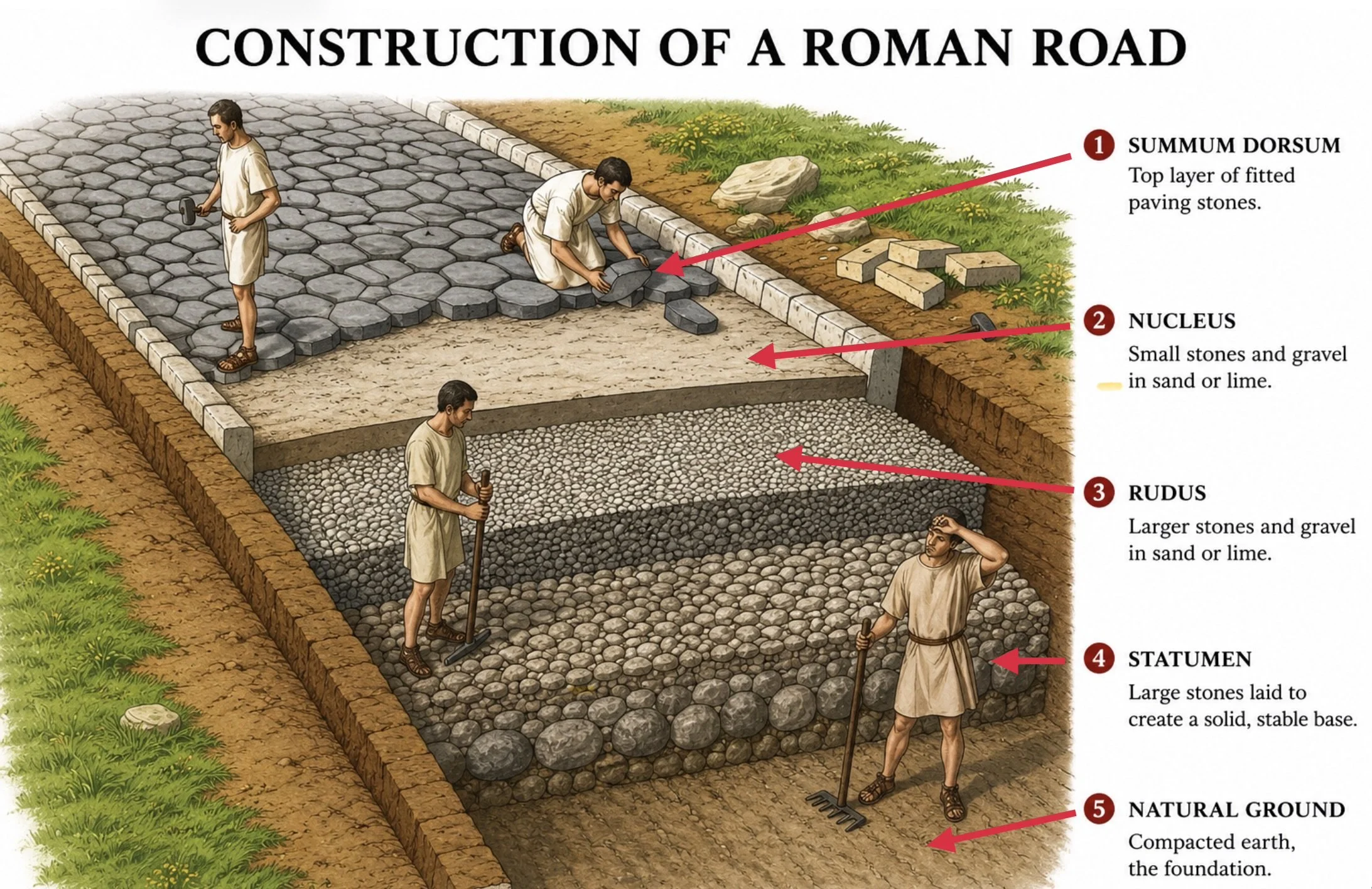
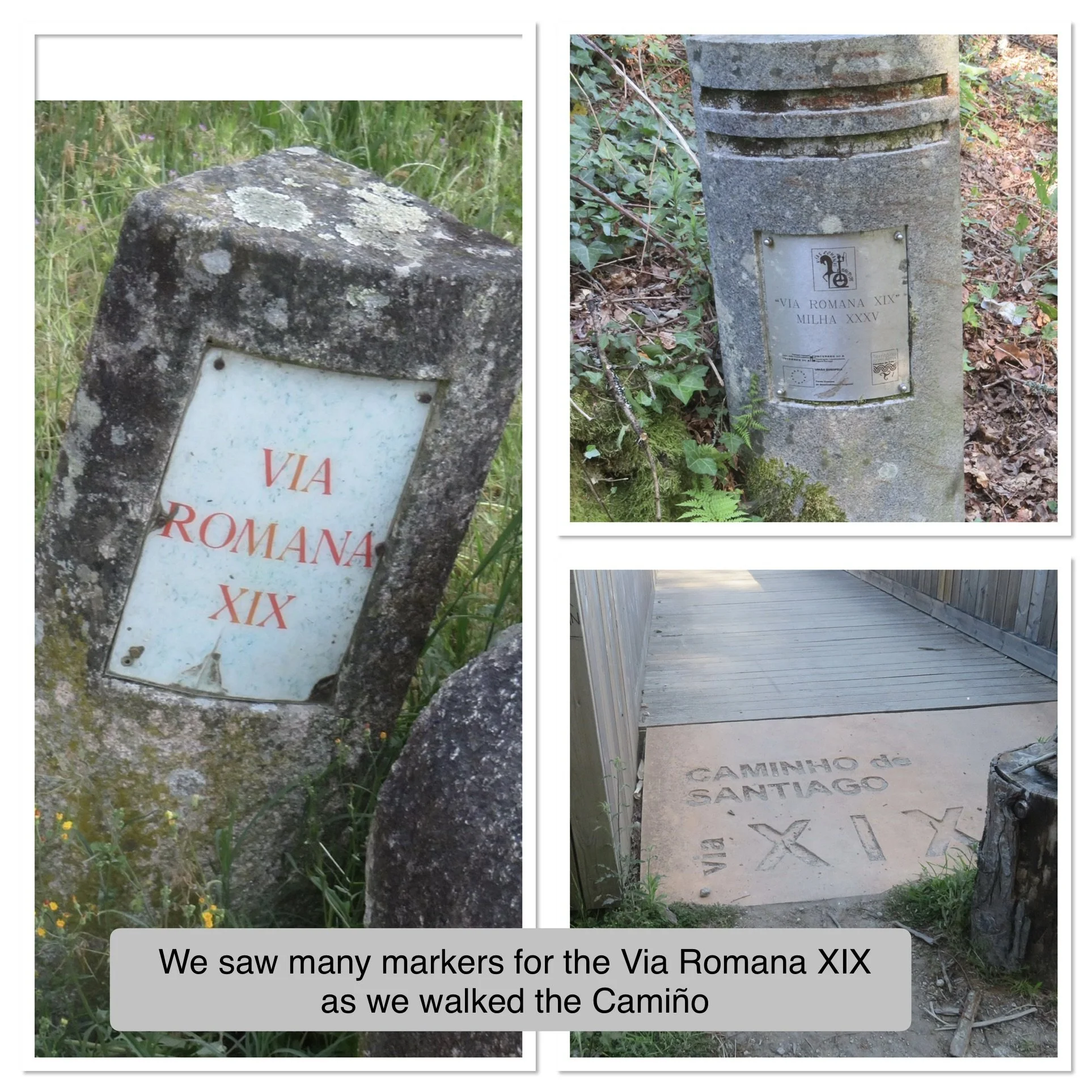
Many roads also included curbstones, footpaths, drainage channels, and milestones marking distances. Travelers could stop at ‘mansions’ — official roadside inns and relay stations — where horses could be changed and officials could rest.
Construction itself required enormous manpower. Roman soldiers often helped build roads alongside laborers, engineers, surveyors, stonemasons, and slaves. Quarrying and transporting the stone alone would have been a colossal undertaking. Yet somehow, across mountains, forests, marshes, and rivers, they created a network so extensive that parts remain visible after two millennia.
And then there are the bridges.
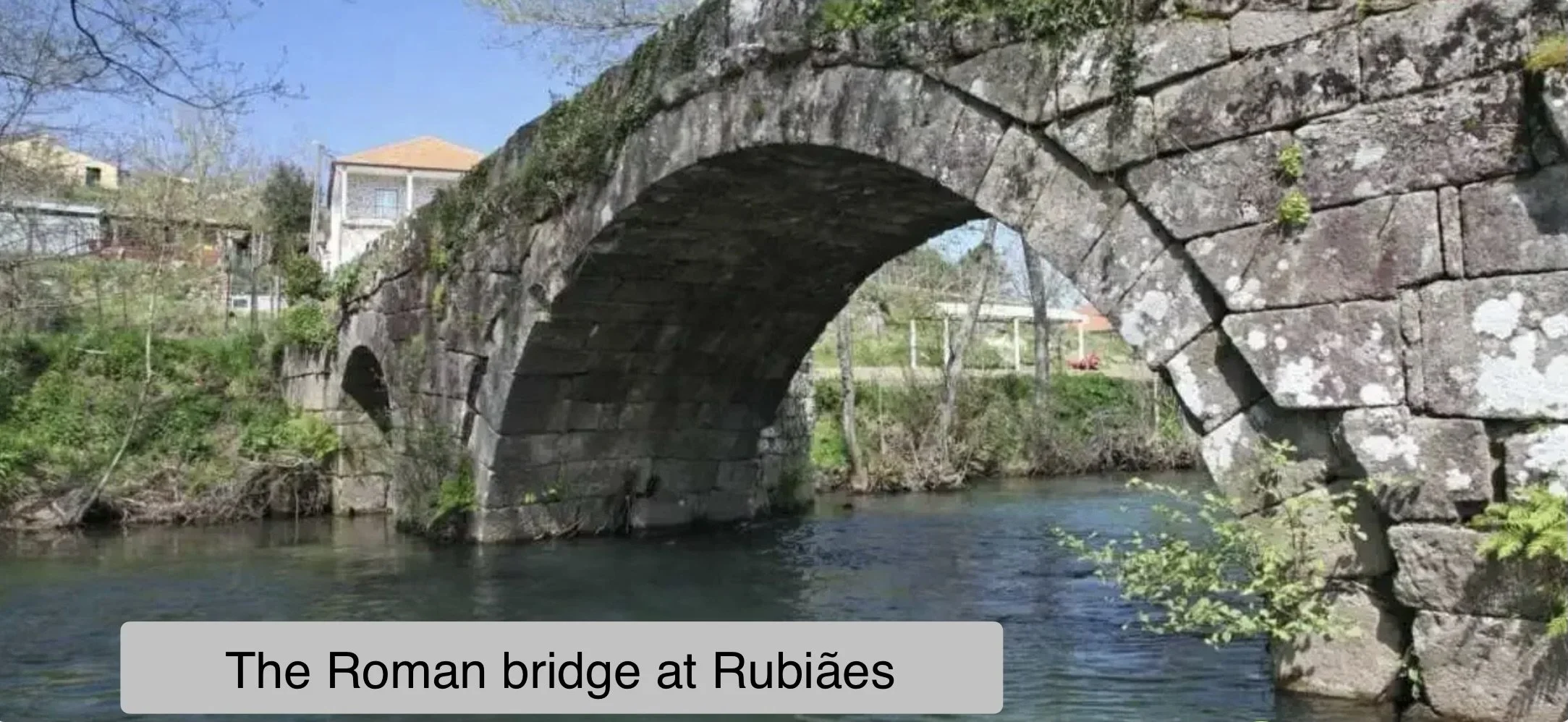
Perhaps nothing demonstrates Roman engineering brilliance more clearly than their bridges. Along the Camino, crossing one of these ancient structures feels almost surreal. You are not simply looking at history — you are physically trusting your weight to engineering designed before the birth of modern Europe.
The genius of Roman bridge building lay in their mastery of the arch.
At first glance, an arch appears simple, but its strength is extraordinary. Unlike a flat beam, which bends under weight, an arch transfers pressure sideways and downward into its supports. Every stone pushes against the next, creating compression throughout the structure. Stone is exceptionally strong under compression, which is why Roman arches could carry immense loads.
The key element was the keystone — the wedge-shaped stone placed at the very top centre of the arch. Once inserted, it locked all the surrounding stones into position. Remove the keystone, and the arch collapses. Place it correctly, and the entire structure becomes self-supporting.
Building the arch required remarkable precision.
Roman builders first erected a large wooden framework called centering. This temporary wooden skeleton supported the arch while it was under construction. Skilled masons then placed carefully cut wedge-shaped stones, called voussoirs, from both sides simultaneously. Each stone had to be shaped perfectly so the pressure was distributed evenly.
When the final keystone was inserted, the weight shifted through the curve of the arch and into the supporting piers below. Only then could the wooden framework be removed.
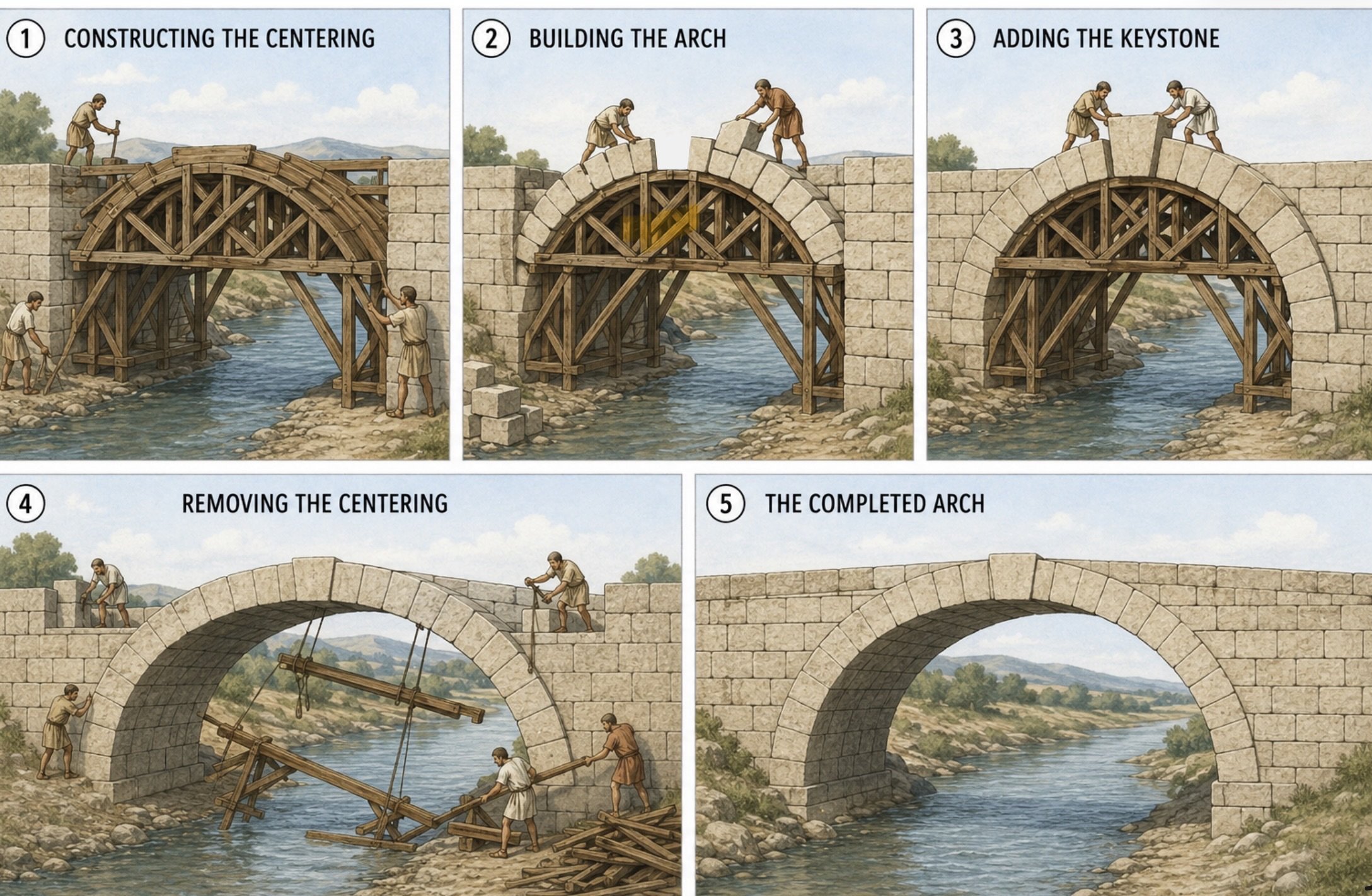
The result was astonishing durability. Many Roman bridges are still standing because they were massively over-engineered. The Romans built not merely for decades, but for centuries.
As we walk the Camino, it is easy to focus only on the present— the next hill, the next coffee stop, the next hostel. But beneath our feet lies another journey entirely.
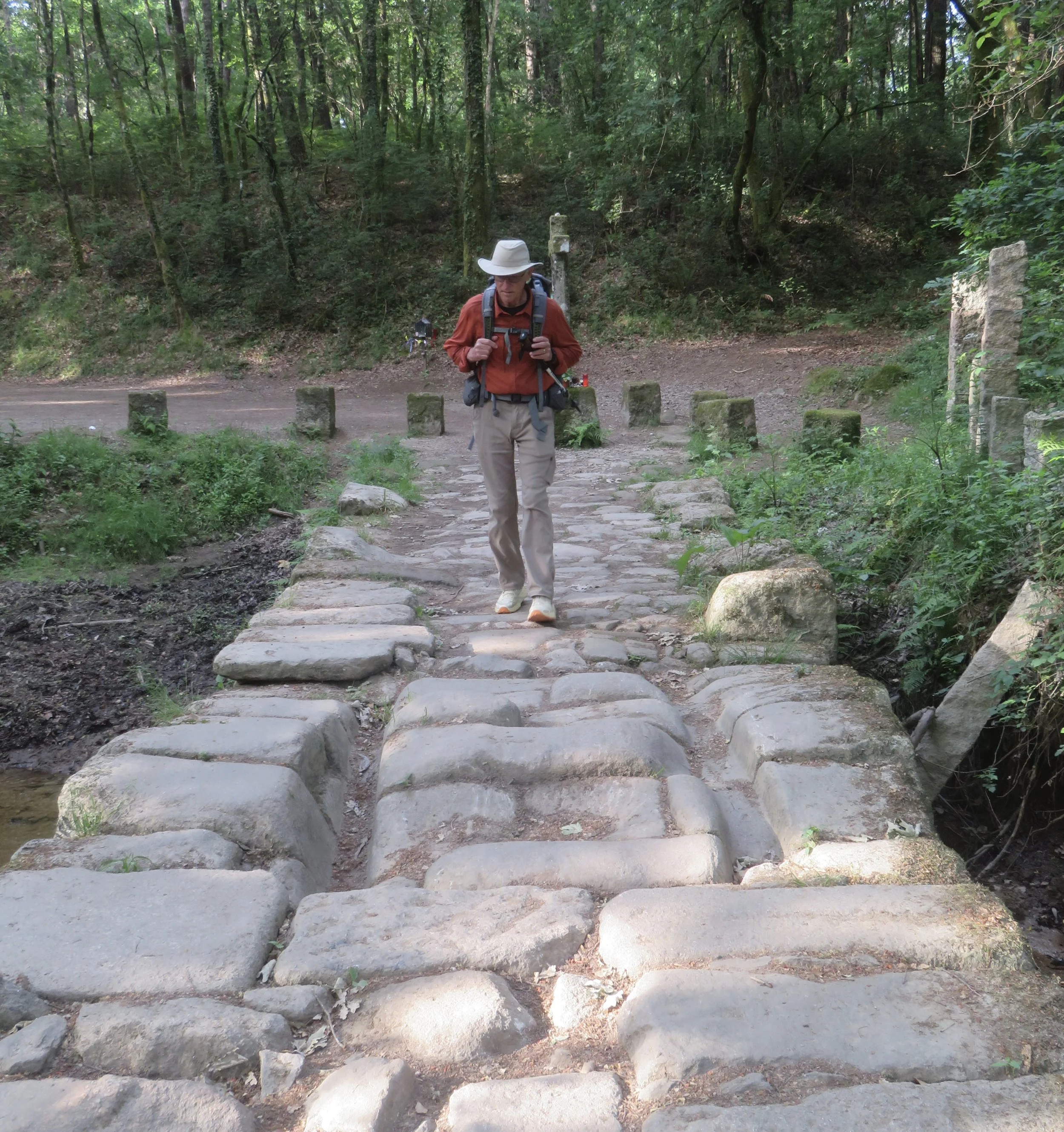
Every stone on the Via XIX carries echoes of soldiers, merchants, engineers, pilgrims, and travelers stretching back two thousand years. The Romans could never have imagined modern pilgrims walking their roads with backpacks and smartphones, yet their work continues to carry us across the landscape.
That may be the most remarkable thing of all. Empires vanished. Borders changed. Languages evolved. Yet the roads are still here.