
The Knights Templar: History Versus Myth
/
Few organizations in medieval history have inspired as much fascination as the Knights Templar. Warrior monks, crusaders, financiers, and eventually victims of political and religious persecution, the Templars have become legends far beyond their historical reality. I was fascinated by the Order long before we visited the Templar castle in Tomar. To prepare for the visit, I read Michael Haag's well-researched book, The Templars: The History and the Myth. What follows is an exploration of the Order's true history—and an attempt to separate fact from centuries of speculation and legend.
The Birth of the Templars
The Knights Templar emerged in the aftermath of the First Crusade. Around 1119, a small group of French knights led by Hugues de Payens formed a religious military order dedicated to protecting Christian pilgrims traveling to Jerusalem.
King Baldwin II of Jerusalem granted the knights quarters on the Temple Mount, believed to be the site of the ancient Temple of Solomon. From this location came their official name: the Poor Fellow-Soldiers of Christ and of the Temple of Solomon—better known as the Knights Templar.
Unlike ordinary knights, the Templars combined monastic vows with military service. They pledged poverty, chastity, and obedience while serving as professional soldiers in defense of the Christian states established in the Holy Land.
From Humble Order to Global Power
According to Haag, the Templars quickly evolved into one of the most powerful institutions in medieval Europe. Their reputation for discipline, courage, and religious devotion attracted support from kings, nobles, and the Church. Donations of land, castles, and wealth poured in from across Europe.
The Order built a highly organized network stretching from England and France to the Middle East. Templar fortresses guarded strategic routes, while their financial system allowed pilgrims and nobles to deposit funds in one location and withdraw them in another. Though not a bank in the modern sense, the Templars pioneered many financial practices that foreshadowed international banking.
By the 12th and 13th centuries, they had become far more than a military order. They were landowners, administrators, diplomats, and financiers with influence throughout Christendom.
The Crusades and the Defense of the Holy Land
Following the First Crusade, a series of Crusader states were established in the eastern Mediterranean. Once the initial campaigns ended, many European knights returned home, leaving these territories vulnerable.
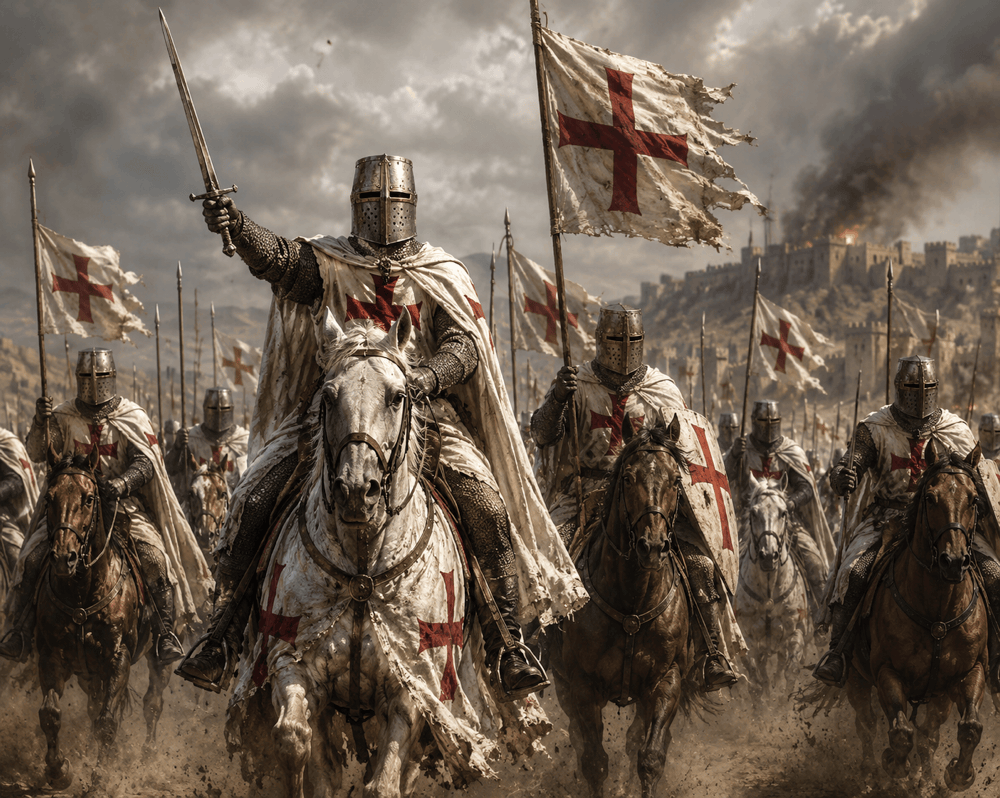
The Templars became one of the principal military forces responsible for defending the Crusader states. They fought in major engagements against Muslim armies, including those led by Saladin, and earned a reputation for exceptional discipline and battlefield courage.
Their rule required them to stand their ground even under desperate circumstances. Surrender was discouraged, and retreat was permitted only under exceptional conditions. As a result, many Templars died in battle, contributing to their reputation as fearless warriors.
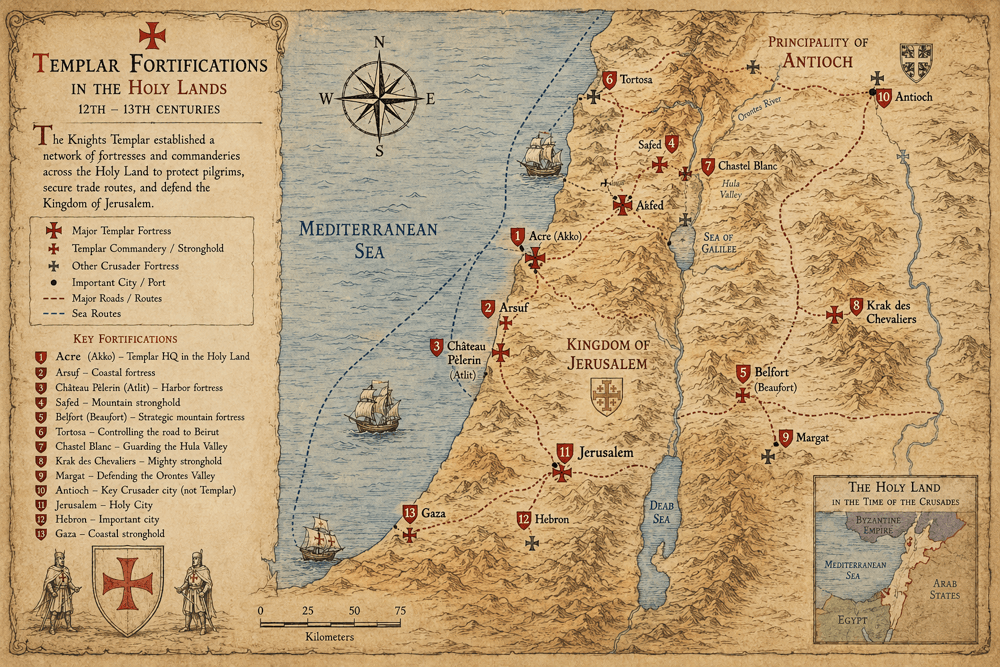
Templar Fortifications in the Holy Lands
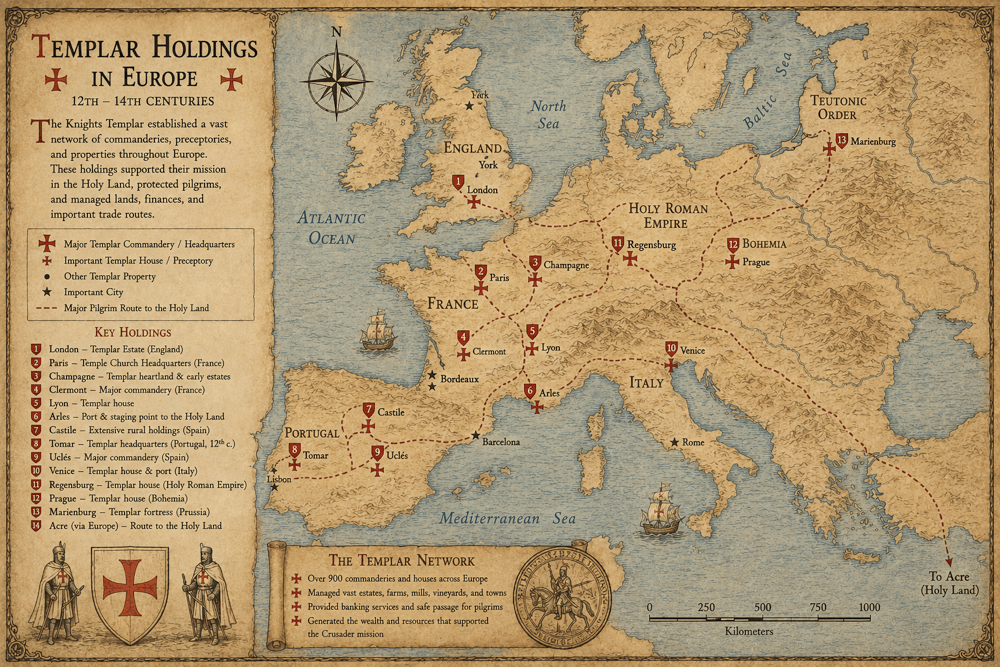
Templar Holdings in Europe
The Destruction of the Order
The downfall of the Templars remains one of the most dramatic episodes in medieval history.
On Friday, October 13, 1307, King Philip IV of France launched a coordinated operation against the order. Acting on sealed orders distributed in advance, royal officials simultaneously arrested hundreds of Templars throughout France.
The king accused them of heresy, blasphemy, idol worship, corruption, and various immoral acts. Modern historians generally regard these charges as fabricated or grossly exaggerated. Philip was deeply indebted to the order and viewed the Templars' wealth and independence as a threat.
The imprisoned Templars were handed over to inquisitorial authorities. Under torture, many confessed to crimes they almost certainly had not committed.
The End of the Order
Under intense pressure from Philip, Pope Clement V formally dissolved the order in 1312. Most Templar properties were seized by the church, although Philip retained substantial assets and revenues within France.
The arrests of 1307 did not immediately lead to executions. The process unfolded over several years. In 1310, fifty-four Templars were burned at the stake in Paris after retracting confessions obtained under torture.
The Execution of Jacques de Molay
The final chapter came on March 18, 1314, when Grand Master Jacques de Molay was burned alive in Paris after publicly withdrawing his earlier confession.
According to legend, de Molay used his final moments to cry out a curse against Pope Clement V and King Philip IV of France, summoning them both to answer for their crimes before the tribunal of God within a year. Whether he actually did utter such a curse remains uncertain, but the chilling myth took on a life of its own because both men died unexpectedly within a year of Molay’s death: Pope Clement V passed away 33 days later, and King Philip IV died several months after from a sudden stroke while hunting.
While the mass arrests of Friday, October 13, 1307, became one of the most famous dates in Templar history, historians remain skeptical that the modern superstition surrounding Friday the 13th can be directly traced to those events.
Survival in Portugal
The Templars met a very different fate in Portugal.
Recognizing their military value and the importance of their resources, King Dinis I sought a solution that would preserve the Order's assets while complying with papal directives. Rather than persecuting the Templars, he worked with Pope John XXII to create a successor organization known as the Order of Christ in 1319.
In practical terms, the Portuguese Templar organization survived intact under a new name. Many former Templars joined the new order, and its wealth, lands, and expertise remained in Portuguese hands.
The Order was initially headquartered in Castro Marim before relocating to the former Templar stronghold at Tomar in 1356.
The Myths That Followed
The Templars' sudden downfall created fertile ground for centuries of speculation.
Stories emerged linking them to hidden treasure, the Ark of the Covenant, the Holy Grail, secret bloodlines, and mysterious occult knowledge. Despite their popularity, most of these claims lack credible historical evidence.
Yet the myths persist because the true story is already remarkable: warrior monks, immense wealth, political betrayal, secret trials, torture, and destruction at the hands of a king.
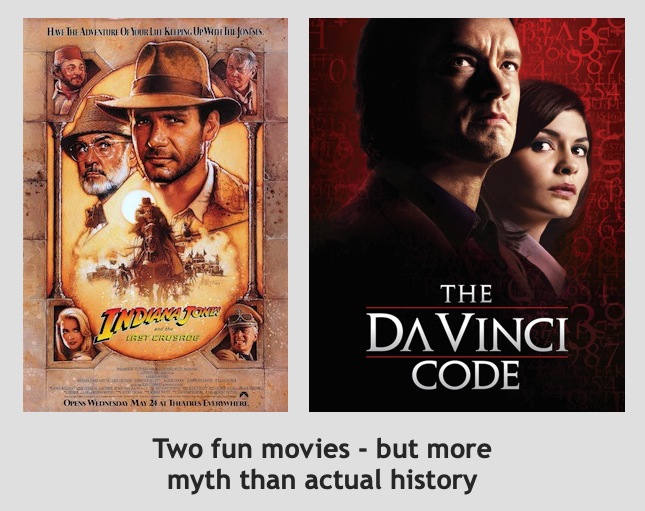
Modern books and films—from Indiana Jones and the Last Crusade to The Da Vinci Code—have further transformed the Templars into mystical guardians of ancient secrets.
The Templars' Lasting Legacy
Although the order was dissolved more than seven centuries ago, its influence can still be seen in finance, military organization, architecture, and even the Age of Discovery.
Banking and Finance
The Templars developed sophisticated financial services for pilgrims, nobles, and monarchs. Depositors could place funds in one region and retrieve them elsewhere using written documentation, reducing the risk of carrying large sums across dangerous territory.
They also issued credit instruments and provided loans to rulers throughout Europe. Their financial expertise helped lay foundations for later banking systems.
Military Organization
The Templars maintained one of the most disciplined military structures of the medieval world. They established clear chains of command, standardized procedures, and logistical networks that operated across multiple countries.
Their model demonstrated how a professional standing force could function beyond the feudal obligations that characterized most medieval armies.
Architecture and Engineering
Templar churches often featured circular designs inspired by Jerusalem's Church of the Holy Sepulchre. Their castles and fortifications incorporated advanced defensive features that influenced military architecture for generations.
The Castle of Tomar remains one of the finest surviving examples of their engineering and architectural legacy.
Financing the Age of Discovery
The successor Order of Christ played an important role in Portugal's maritime expansion.
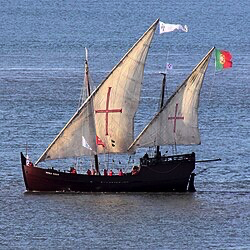
In 1420, Prince Henry the Navigator became head of the Order of Christ. The Order's substantial resources helped support shipbuilding, navigation research, cartography, and voyages along the coast of Africa.
In particular, the Portuguese caravel was developed under his patronage. By merging the agile hull of regional fishing boats with Arab lateen rigging, the Portuguese created a fast, maneuverable vessel that catalyzed the Age of Discovery.
The Iconic Red Cross
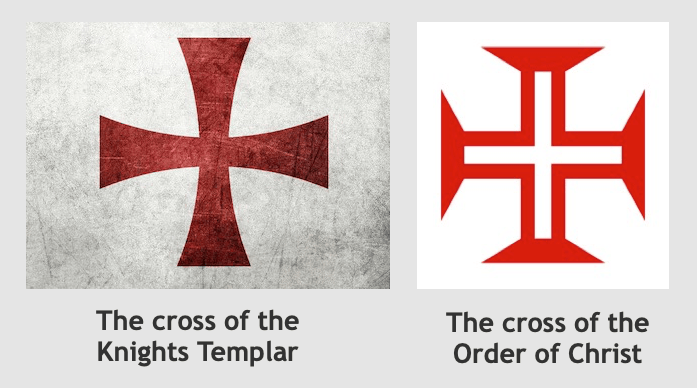
One of the most visible reminders of the Templars survived in the emblem of the Order of Christ. Its distinctive red cross appeared on Portuguese ships during the great voyages of exploration.
The sails of vessels commanded by explorers such as Vasco da Gama carried a symbol directly descended from the Templar tradition, linking Portugal's age of exploration to one of medieval Europe's most famous military orders.
Conclusion
While the Knights Templar were neither the guardians of the Holy Grail nor keepers of secret supernatural knowledge, their real story is just as fascinating. They rose from a small band of knights protecting pilgrims to become one of the most influential organizations in medieval Europe before falling victim to politics, debt, and royal ambition.