
En Route to Guyana

Day 1 Though we would be perfectly happy to remain moored in the Suriname River for another month or two, once again it's time to move on. We're heading to Guyana, the only one of South America's 13 countries that we haven't visited. We paid off the marina, then walked over to our favorite little supermarket here in Domburg yesterday afternoon and spent the last of our Suriname dollars on bread, tomatoes and yogurt. We held out SU$14 for a djogo of Parbo beer at the River Breeze to share with some cruiser friends. We ended up with 35 Suriname cents … not bad planning.

We had checked out with Immigration (Suriname Military Police) on our last visit to Paramaribo while we still had the car. Their office is closed on weekends, but the officials were perfectly happy to exit-stamp our passports on Friday for departure early Monday morning. It's been great here, but already our thoughts are concentrated on following our track down the Suriname River back to the Atlantic, sailing 185nm along the Suriname/Guyana coasts and then heading up the Essequibo River about 40nm to Bartica. The total charted route is about 260nm... about three days from anchorage to anchorage, depending on currents, winds and tides. No more oceans to cross … no more long passages for awhile.

route to guyana

We were off to a stuttering start. We planned to leave on Monday and then decided at the last minute to hang out for one more day. We manufactured all sorts of excuses, but in the end, it just came down to deciding we just felt like waiting a day. It's not like we have plane tickets … we have options for departure times and we exercise them frequently, as you well  know.

Tuesday morning had us scurrying around as if it was a surprise that we were actually leaving. We were up early enough. What started the “scurry” was hearing chirping welcome swallows, but not seeing them anywhere on the boat. Seems they had perched beside the boat on several large tree branches that were all tangled up in the mooring lines.
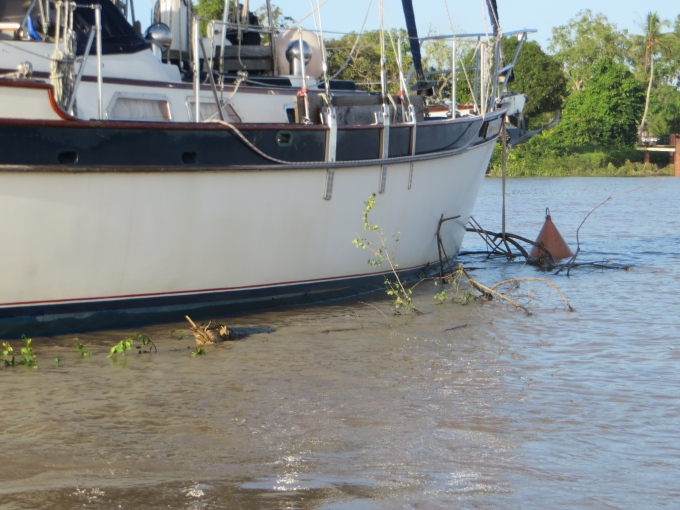
tree around the boat

We used the dinghy to try to remove them, but the current was still too strong. We went ashore, got rid of trash, did internet and topped up the water. When we returned an hour later, the current had subsided enough to allow us to untangle the mess. It took nearly an hour to rid ourselves of the unwanted forest and untangle the mooring lines.

untangling the tree


untangling the mooring lines

We hauled the dinghy, but of course, its time in the muddy river had left it dirty. While David tackled the dinghy cleaning, I made sandwiches, cooked chicken for dinner and made ready below. Another hour gone. By 10am, just as the tide was changing, we dropped the last mooring line and we were heading 35nm north back down the Suriname River.

under the bridge

The day was gorgeous, with a few sprinkles here and there, but nothing to complain about. We cleared the mouth of the river in 4.5 hours. The last hour wasn't pleasant with wind against current, but it was short-lived. We hoisted the main, let out the jib and had a perfect beam reach sail till almost 7pm … wind and current in our favor. Then, the wind died, the dark enveloped us and little fishing boats with only black flags identifying the end of their vast mile-long nets were in great numbers.

We opted to stop for the night, drop the hook, get some dinner and sleep and continue in the morning. We lit up Cups like a Christmas tree, set the anchor, radar and AIS alarms and tried to get some sleep. Bad idea! We were seasick almost immediately. The boat rolled and pitched, but the thought of hauling anchor was even worse. We toughed out the night, leaving us sleepless, sore and unrested by daylight … and still no wind … but the seasickness was gone.

Day 2

We downloaded Doyle's Cruising Guide to Guyana before we left. It's a work in progress and the download is  free. We've read it from cover to cover with all its associated updates. The Essequibo River has few navigational aids and the Navionics charts are known to be a bit off. The guide provides waypoints, hints and info accumulated from previous cruisers. Of course, it's a river and things change, but it's a good navigational aid when used in conjunction with caution, common sense and eyeballs. David had loaded the waypoints into the iPad and the chartplotter. We checked them twice, found one small error to correct, then concentrated on enjoying the day, which included several naps to make up for the previous night's lack of sleep.

doyles cruising guide

Jack and Jo, formerly of Mystic Adventure and longtime cruising friends, made this trip over a decade ago in 2004. Jack made  excellent notes which he published back then. Before we left Suriname, we dug them out, read them and then contacted Jack to let him know we were following in his track. Even today, very few yachts visit Guyana. It has a rough reputation and minimal infrastructure to support tourism. Jack, however, still had contact with Kit Nascimento, former advisor and PR guy for Guyana's Minister of Tourism. He and his wife Gem, are both still involved in the tourism industry and keen to have yachties visit. Jack introduced us via email, we heard from Kit within a day with an invitation to anchor off his place during our stay. We now have a solid, friendly contact in Guyana. That's how it works in the cruising community … like a charm.

Today was a rather nondescript kind of passage day. The wind remained below 8 knots and we dawdled along in the 3 knot range for the most of the day. The water is clear and green again and we're enjoying its clarity for a few days before it turns muddy brown again. We finally decided to turn on the iron jenny (engine) at 1500. At our current speed, we'd arrive at the river mouth too late and have to spend another day waiting for the tides. We puttered along at 6 knots. A late afternoon wind finally came up an hour later and, all sails full, we cruised along at 7 knots for the rest of the night on a beam reach. A buttery half moon rose. The stars were out in vast numbers. The 15-20kt wind was warm on our faces, but cool enough to be refreshing. Absolutely glorious.

We're not very far offshore...maybe 20 nm or so. Flocks of  gulls and terns fly by, following the fishing boats, which are also in great numbers.

gulls in guyana

fishing boat in guyana

We're catching up on naps, very content with being under sail again. We do, however, need to adjust our ETA a bit … more like 3-4 days.

Eclectic Suriname

As we prepare to leave Suriname, I've found that I have lots of photos that just didn't fit into any blogs, but might give you a feel for the place. powerplant in paramaribo

wooden plank bridge in suriname

lotus in suriname

homeless in suriname

dilapidated wharf in paramaribo

suriname river bridge

welcome to paramaribo

macaws in paramaribo

diwali celebration

suriname house

traffic in suriname

road in domburg suriname

abandoned corial in suriname

We liked Suriname very much, but didn't get to explore as much of it as we would have liked in our two week stay. We would have enjoyed mingling more with the locals and learning more about the diverse cultures here. There was so much we could have seen and done, but the clock ticks on and we want to move on to Guyana before heading to Trinidad. We have less than a month now and we're feeling rushed. Yikes!

Dutch word for the day? Vaarwel – Farewell

The Blue View - Windlass Controllers

windlass foot switch As I write this, we are in Suriname, moored near the tiny town of Domburg. A couple of nights ago, an American catamaran sailed in after a passage from Brazil. When they tried to anchor, their windlass jammed with the anchor partially deployed. They had just enough rode out to snag on the bottom, but not enough to hold the boat in place. As they tried to fix the problem, they ended up hitting another boat, then getting thoroughly entangled with it. After a bit of spirited language and a few hours of work, they were finally able to get clear of the other boat and anchor. There were a few rookie mistakes involved, but I shan't pass any judgments – Lordy, we've certainly made our share of mistakes along the way.

It did, however, remind me of the love-hate relationship we have with our windlass, that big, fat hunk of metal that raises and lowers the anchor. With the size of our anchor and the amount of chain we use, it is a very important piece of gear, and something we depend on. When it is working, we love it, but it's a royal pain when it isn't.

In a calm, flat anchorage, I might still be able to haul in a couple hundred pounds of dead weight by hand (I see Marcie smirking about this claim), but it would be a struggle. An alternative would be to use a line attached to a cockpit winch, and winch the chain onto the deck, 25 feet at a time. It would be slow and messy, but the winch would get the job done. When conditions change, however, and we need to leave in a hurry, a working windlass on Nine of Cups becomes essential. We both remember trying to leave a deep anchorage at Tristan de Cunha when the wind shifted and the anchorage became untenable. We were taking waves over the bow and when our venerable old windlass crapped out, Marcie struggled to keep us off the rocks while I hauled in all 250 feet (75m) of chain and our 110 lb. (50kg) anchor. It took hours. Not something I'd want to do on a routine basis.

I've devoted a couple of blogs to windlasses and how we replaced ours. Just as important is the windlass controller. The windlass isn't much good if the switches that operate it aren't reliable. We've tried several different methods, some of which worked well and some of which didn't.

windlass control option 1

When we bought Nine of Cups, she had a heavy-duty Maxwell windlass that was operated by two deck mounted foot switches. The system was simple and straightforward – when you stepped on one of the foot switches, the contacts of the switch connected the 12 VDC to the windlass motor. This approach, while simple, had two problems.

The first problem was the 150 amps of current that passed through the switch contacts. In the salty environment in which the switches live, conducting that much current through the switch contacts caused a lot of arcing, which in turn, caused the contacts to pit and deteriorate. I think I replaced those switches once a year for the first three years we owned Cups before I got wise to the problem.

windlass control option 2

In the next iteration, I used a windlass motor control module. In this option, only a relatively small 3-5 amps of current passes through the foot switches, and the solid state relays of the motor controller handle the 150 amps required by the windlass. The foot switches now last many years instead of just one.

The second problem was damage to the deck core from water ingress. Whoever originally installed the deck switches did nothing to protect the core except caulk under the foot switches. Eventually, water made its way into the core, causing the core to deteriorate and the bond between the core and deck to weaken. When we were in New Zealand a few years ago, I removed the top of the foredeck, replaced the wet, damaged core, epoxied it and the deck back together, then fared and repainted the whole area. The job turned out well, and is probably stronger than when new, but it was a lot of work. It would have been a lot easier to prevent the damage to begin with.

windlass control fastener

Any time I drill a hole in the deck, I do what I can to protect the core from water damage. If I am using self tapping screws, I first drill a hole in the proper location. The hole should be the proper size for the screw and slightly longer than the screw length. Then I increase the hole size by .25” (6mm), about 75% of the depth that the screw will penetrate the core. I will want to remove the screw and fitting later, so I coat both with wax or silicone grease. Then I use a Q-tip to paint the inside of the hole with epoxy. As it is kicking, I mix a batch of thickened epoxy, about the consistency of ketchup, and pour it into the hole. Then I position the fitting and screw the fastener in place. I use just enough pressure to hold the fitting in place. Once the epoxy has cured, I remove the parts, caulk underneath the fitting, and screw it back in place, tightening the screws enough to make a good seal, but not enough to squeeze all the caulk out from under the fitting.

switchfoot epoxy

Any hole that penetrates the bottom layer of the deck, like the hole for the foot switch for example, should be temporarily sealed from the bottom to prevent the epoxy from dripping down into the interior. If it is a small hole, I make a plug from modeling clay. If it is a large hole, I attach a piece of scrap plywood to the underside of the deck using a glue gun. I use only enough to tack the wood in place, so it's not too difficult to remove later. Then I seal any gaps between the plywood and the lower surface of the deck with modeling clay. Next, I paint the core with epoxy to wet it out, and give it a coat of thickened epoxy. In this case, the epoxy should be thicker – maybe the consistency of peanut butter, to keep it from sagging too much.

All this sounds like a lot of work, but the hour you spend now will save a few weeks work repairing a spongy deck core down the road.

Stay tuned – in the next blog I'll talk about making a handheld windlass controller, and, if you aren't too “windlass controller-ed” out by then, I'll show you my nifty digital chain counter.

Marcie's comment: “Geek sailors of the world unite!”