Taking a Leap - How to use an extra day

happy leap day Every fourth year or so we pick up an extra day in our calendar and luckily 2016 is one of those years. Leap Day, February 29th, is a welcome addition to our schedule. We need some extra time to get our lives in order before we head back home in a couple weeks to Nine of Cups in Trinidad.

So how come we get all this extra time? According to Rich Exner at cleveland.com, it's a bit more complicated than I thought. “Most everyone knows that leap year is a calendar-balancing act, so our calendars don't get out of whack over time. A year, based on the Earth's orbit, lasts 365 days, five hours, 48 minutes and 46 seconds. Put another way, that's 365.2422 days long. A normal calendar year is 365 days. Over four years, that would add up to 1,460 days. But, based on the Earth's orbit, we really have covered nearly 1,461 days. So, Feb. 29 is added in leap years to bring us up to 1,461 calendar days.”

But that's still not exactly precise. “The math-gifted know that four years on the calendar actually last 1,460.9688 days, not 1,461 days. A little difference can add up to a big difference over time. So every 100 years, we don't observe a leap year. There was no leap year in 1800 and no leap year in 1900. What about 2000 ... it was a leap year? Skipping a leap year every 100 years solves much of the problem, but not all of it. So every 400 years, there's another twist. There is a leap day in years ending with 00 if the year is divisible by 400. That made 2000 a leap year and it will be the case again in 2400.

But 2100, 2200 and 2300 will not be leap years. This system will keep us on track for 3,333 years.”

Whew … I was worried.

It was Julius Caesar, by the way, that introduced the first leap every four years. There ended up being too many leap years, so the Romans added an extra month every once in awhile to coincide with the change of the seasons. It stayed that way until 1582 when the Gregorian calendar, the one we use today, was introduced. Some calendars have leap months. The Chinese lunisolar calendar has 13 months every three years. The Ethiopian calendar (yes, there is an Ethiopian calendar) has 13 months

Now that we have the extra day, what are we going to do with it? Aha … I've got that all figured out.

I've scheduled our IRS tax prep that morning, as well as several other irritating little chores while David works on projects at the new house. There's still more moving to be done and stuff to be packed and subsequently unpacked.

Traditionally, if a woman asks a man to marry her on leap day, he must oblige. If not, he must pay a penalty. In some countries, a man who refused would provide the rejected woman with gloves to hide the embarrassment of a missing engagement ring on her finger. Since David obliged me ~30 years ago (actually he asked me...just to set the record straight), I thought I'd turn the tables and invite him out to lunch. MY treat (OUR budget). Since I doubt I'll convince anyone in the family to play leap frog, I thought I'd find a copy of Leap Year to watch in the evening. I know it's a chick flick, but while sipping extra dry champagne on our extra day, David will hardly notice.

 

The Wonders of Travel

Ibn battuta

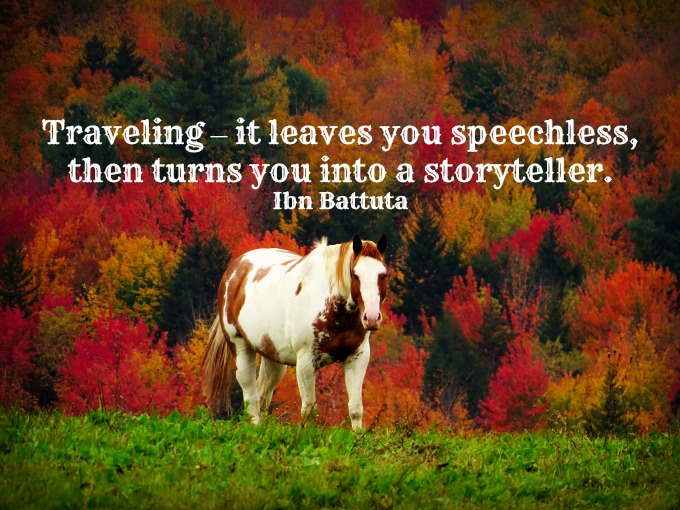
"Traveling - It leaves you speechless, then turns you into a storyteller" - Ibn Battuta

Okay, first of all you're asking, “who the heck is Ibn Battuta, did I spell his name wrong (Ibn?), what does he have to do with traveling, and why do I care?” Ibn Battuta, was a medieval Muslim/Berber traveler and scholar, who is widely recognized as one of the greatest travelers of all time.” He traveled more extensively and for longer than Marco Polo, a contemporary. Considering the challenges of the time, he certainly got around. He was one of the earliest travelers with a documented case of a travel bug bite.

Some things don't change over time. It's the same for us traveling in the 21st century as it was for Battuta back in the 14th century, except we have a GPS and a Lonely Planet. We are many times left speechless by what we see and experience. The view of the morning mist clearing to reveal Machu Picchu below us while we perched above at Huayna Picchu is forever etched in our memories.

view of macchu picchu

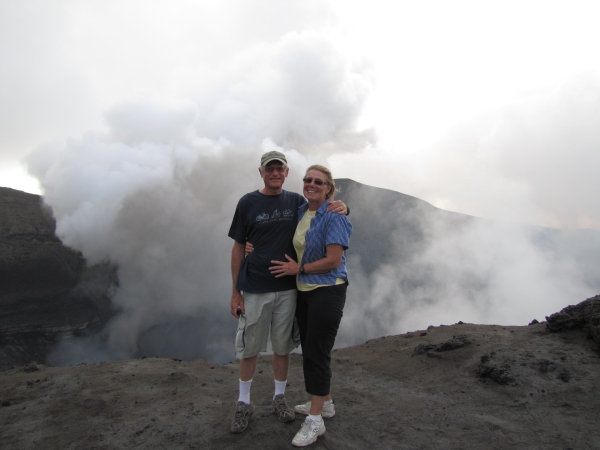
Standing on the edge of the active Mount Yasur Volcano in Tanna, Vanuatu, feeling the ground tremble beneath our feet and the fiery heat on our faces as it erupted, smelling the strong sulphur fumes, watching boulders being spewed into the sky … that took our breaths away.

volcano at vanuatu

We're just as likely, however, to be speechless when we see a pod of dolphins or a gorgeous sunrise or sunset at sea or the leaves changing color in my native New England. No matter how many times we see everyday occurrences, we're enthralled all over again.

sunrise at waldegrave

And then comes the storytelling … to anyone who will listen. How can you experience such wondrous, astonishing, incredible things in the world and not want to talk about them and share them? On his deathbed, Marco Polo reputedly said “I did not write half of what I saw, for I knew I would not be believed”. Our storytelling is done through our website and daily blog. We've also done lots of seminars and presentations … from yacht clubs to schools to assisted living facilities. If folks are interested, we'll talk their ears off. We travel, we experience, we share and relive each experience all over again.

I wrote once, “Part of the pleasure I derive from living on a boat and traveling around the world comes from documenting and sharing the adventure. Granted, I’m just as apt to write about bugs, Vegemite and vinegar as I am to extol the splendors of Tahiti or Machu Picchu, but still, irrespective of the subject, I seem to be driven to get it down on “paper” and share it.”

Thanks for traveling with us and listening to our stories.

Buying a House - It just ain't the same

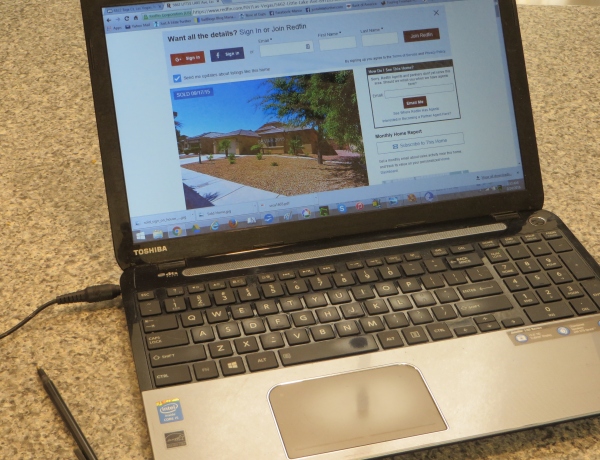
We've bought several houses over the years. We'd look in the big, fat MLS book, find something we liked, then we'd contact the agent and have a look. If we liked it, we made an offer. We'd negotiate with the Seller a bit, agree on a price, then go sit down with our bank or mortgage lender to arrange the mortgage and the details. We met the banker/mortgage lender in person. We signed contracts and submitted official paperwork. We set a date for the closing where we sat down around a big table with the Sellers, the agents and the bankers and signed the final papers. Money in the form of checks was disbursed, hands were shaken, keys were exchanged and we had a new house. online house buying

In today's electronic world, none of what I described above occurs and I resent it. Some aspects are certainly easier. We didn't thumb through a huge book to find houses we liked. Instead, we input our buying criteria, scrolled through various sites, looked at videos and photos and searched comparable housing prices in the neighborhood. Easy-peasy. When we found a few that met our criteria, our agent set up times to look at them. That part was pretty convenient.

In the meantime, we contacted a local bank, but we didn't know anyone there and they didn't know us. We bank electronically, of course. The bank was not competitive on mortgage rates, so we ended up working with all the body-less voices at Quicken Loans/Rocket Mortgage. We provided a host of people we didn't know with every bit of information about our lives (only our sexual habits excluded) and then some. Explaining that we had no debt, no mortgages and lived on a sailboat for the past 15 years was difficult. It's not something they deal with regularly. They set up a “MyQL” file for each of us to which they sent endless questions and attachments. We “Docu-signed” everything electronically. We didn't get to keep the pens. All the initial work with Quicken earned us our first merit badge … a Qualifying Letter, followed soon thereafter (after we mastered another skill) by our second merit badge, an Approval Letter.

When we (the buyers) finally found the house we wanted to buy, our agent filled out an electronic form with our offer which we signed electronically and he sent electronically to the seller's agent. The seller's agent in turn forwarded our offer to the sellers. The sellers weren't satisfied with our offer, so they had their agent draw up a counter offer form which they signed electronically and in the reverse order, it was forwarded to us via various agents. We weren't satisfied with the counter-offer, so we countered the counter-offer … you get my drift. Though this was supposed to be a streamlined process, it took days and days. Had we sat down at a table with the Sellers, we could have probably ironed out the minor differences in an hour or two.

Then followed several weeks of limbo. The lenders were working on all the paperwork, dissecting our lives, snooping in all the nooks and crannies of our financial lives in order to coax any skeletons out of the closets. None found, they created 134 pages of loan disclosures and loan paperwork which they forced us to read in one sitting without blinking our eyes or falling asleep.

Inspections and appraisals took place which necessitated more electronic negotiations with the sellers via the agents. The “other” agent (depending on whether the seller or buyer's agent was talking) was the cause of all delays, mistakes and misunderstandings. That part of the process reminded us of the old days.

Finally, the big day came … closing day. We arrived promptly at 8am. We met with a notary public whom we didn't know, signed a huge ream of papers … but got to use a real ballpoint pen and our own illegible signatures. We signed early in the morning so that our east coast time mortgage lender could still wire funds to our west coast time escrow agent and they could process the purchase and record the transaction with the county clerk. We walked out of the building with no keys and a big, new mortgage. The sellers had appeared the day before and signed. We never met them nor anyone else.

sold home

What was supposed to happen next ….

All the paperwork was duly recorded. Our agent showed up in the late afternoon with the keys, more paperwork, and a word of congratulations. What was missing? I guess the personal aspects of the whole procedure. Buying a house is a big life event. Knowing the people you're working with is part of the “feel good” aspect. We also missed out on the pieces of information about the house that only the sellers would know and could have shared with us; all that's now lost. We didn't even get to shake hands with them. Totally unsatisfactory!

What actually happened … and it's probably against the rules

The sellers were still cleaning out the house when we stopped by for a final inspection the night before closing. They were warm, friendly and wonderful and certainly not the impersonal, demanding sellers that caused us angst during the negotiations. They allowed us to wander through the house, gave us some history on the house, improvements they'd made, tips on how to care for the wood floors, etc. They had an extra queen size bed that was nearly new, but they didn't have a place for it. Did we want it? (Yes!) The whole experience was wonderful. We left with mutual hugs (never mind shaking hands) and an exchange of contact information. That's how it's supposed to be!